
Most training measures whether people finished a course. Cultivate by Orange Grove Consulting is built around a different question: how capability actually develops, and what a learning platform needs to do to support that growth.

The difference between delivering content and developing capability is the starting point for Cultivate.
Organizations spend heavily on interpersonal and leadership training every year, yet much of it does not produce meaningful behavior change. Completion rates may look good on a dashboard while behavior on the ground looks much the same as it did before. Compliance training is perhaps the clearest example: employees complete the required course, check the box, and organizations can still face the same problems the training was intended to prevent.
Part of the problem is structural. Meaningful development usually requires practice, feedback, reinforcement, and attention to what a particular learner already knows and where that person is struggling. That level of individualized attention is difficult and expensive to deliver consistently through traditional in-person training. As a result, organizations often default to something more scalable but less responsive: the same course, in the same sequence, for everyone.
That approach confuses exposure to content with development of capability. Someone can finish a course without mastering the skill. Someone else may already know half of what the course covers and spend time repeating material that adds little value. A fixed learning path cannot easily distinguish between the two.
A Different Way to Think About Growth
Cultivate is an asynchronous, interactive smart learning platform designed around a simple premise: capability develops over time rather than being delivered all at once. Instead of moving every learner through the same content and hoping it lands, Cultivate responds to how an individual actually performs and adjusts the learning experience accordingly.
We use a growth model to describe this because the metaphor fits the way development actually happens. Growth needs a strong foundation. It takes place through an active process rather than a single exposure. It develops differently from one person to another. And whether new capability ultimately shows up in the workplace depends partly on the conditions surrounding the learner.
The plant is therefore a useful way to visualize the model, but the model itself is straightforward: a strong foundation supports an adaptive growth process that develops skills and competencies, while the organization creates the conditions for those capabilities to translate into impact.
The Five Stages of the Growth Model
Cultivate’s growth model moves through five stages, from the foundation the platform is built on to the impact that becomes visible once new capability is applied on the job.
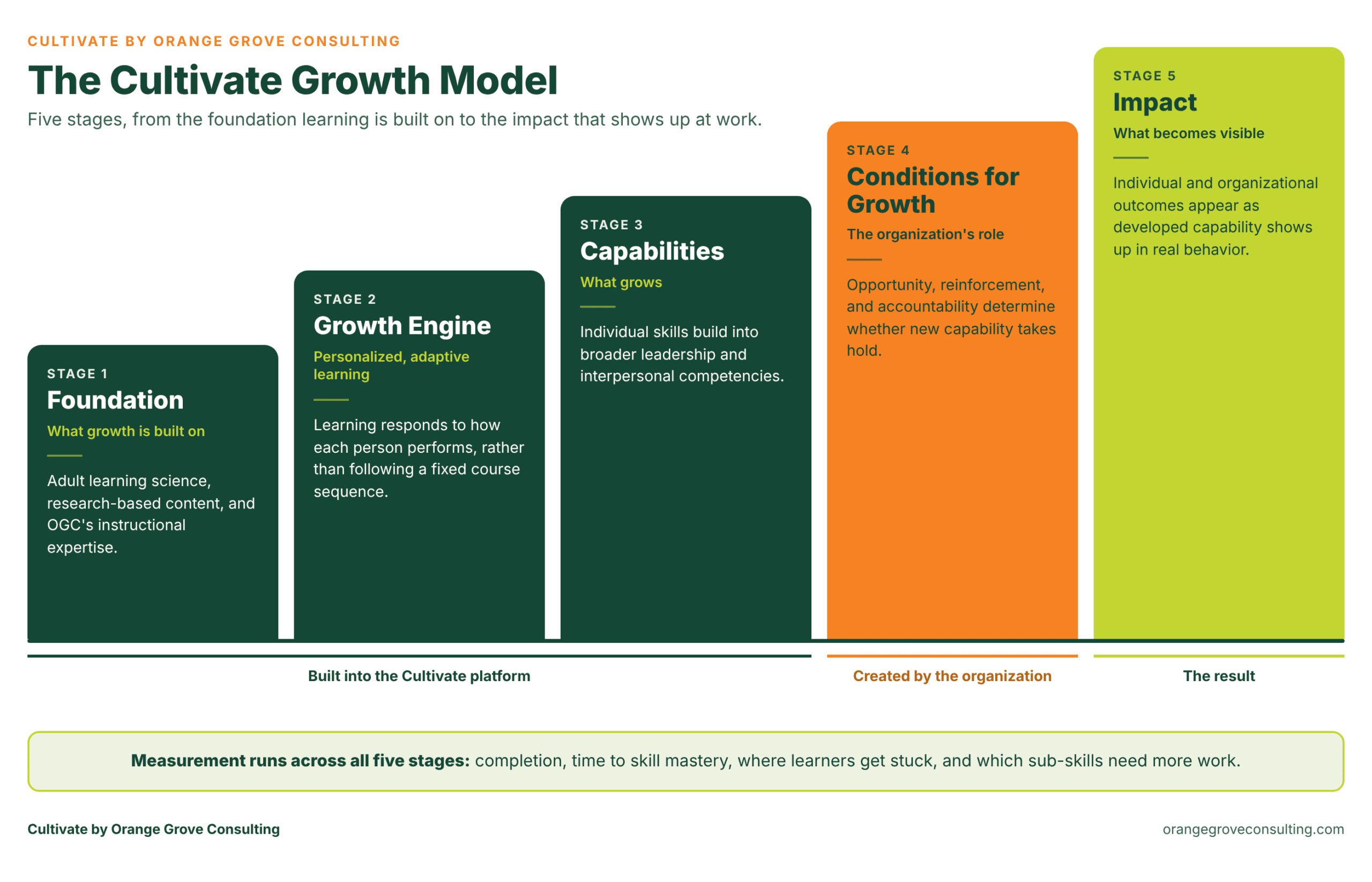
1. Foundation | What Growth is Built On
Every skill needs something solid to grow from. Cultivate’s foundation is the same foundation that has long differentiated Orange Grove Consulting’s synchronous development work.
Adult learning science. The learning experience is grounded in established principles of how adults learn, including active engagement, application, reflection, feedback, and relevance to real work.
Research-based content. Cultivate uses substantive, evidence-informed material rather than reducing complex interpersonal skills to lightweight tips or generic advice.
Instructional expertise. Effective development depends not only on what is taught, but on how people are asked to engage with it. OGC’s experience designing exercises, scenarios, questions, and debriefs informs what learners encounter and what each experience is intended to develop.
This matters because a gamified or technology-enabled experience can easily be mistaken for lighter learning. Cultivate is not built by adding games around generic content. The technology changes how the learning is delivered and personalized; it does not lower the quality of what learners are being asked to understand and do.
2. Growth Engine | Personalized, Adaptive Learning
A strong foundation is necessary, but it is not sufficient. Capability develops through repeated opportunities to make decisions, apply ideas, receive feedback, reflect, and try again. This is the growth engine at the center of Cultivate.
Learners do not begin with a file that tells Cultivate exactly what they know and what they need. They begin by doing. As someone works through missions and scenarios, the platform observes performance. A learner who demonstrates mastery can move toward a more relevant or challenging experience. A learner who struggles can receive reinforcement and additional practice before moving on.
Some missions are designed to surface more than whether a learner succeeded or failed. Larger, multi-layered scenarios can help identify the particular sub-skill creating difficulty within a broader competency. Cultivate can then route the learner toward experiences intended to strengthen that specific area rather than simply flagging the gap or requiring the learner to repeat an entire course.
That is an important distinction from a static content library. A library can offer many choices, but the material itself does not change because of what a particular learner demonstrates. Recommendation engines may suggest content based on what other users selected or rated. Cultivate’s learning path is intended to respond to the individual’s performance.
Sidekick, Cultivate’s AI coach, supports that process by adapting questions and reflection prompts to the learner’s experience rather than running the same coaching script for everyone.
3. Capabilities | What Grows
The purpose of the adaptive process is not completion; it is capability. Cultivate develops the individual skills that contribute to broader competencies such as difficult conversations, delegation, strategic thinking, conflict navigation, and other interpersonal or leadership capabilities.
Development can expand over time. A learner may begin with one area of focus and later move into others as needs change. Within a competency, the platform can concentrate effort where it is most useful rather than assuming every learner needs the same amount of development in every underlying skill.
The sequence is therefore not fixed. Two people working toward the same competency may take different paths because they bring different strengths, experience, and development needs.
When an organization has already defined the competencies it wants to emphasize, Cultivate can align development to those priorities. When it has not, Cultivate can still stand on its own as a capability-building solution.
4. Conditions for Growth | The Organization’s Role
No learning platform, and no classroom program, changes workplace behavior in isolation. A person may develop a skill through training and still have limited opportunity to use it, work for a manager who does not reinforce it, or operate in a system that rewards a different behavior.
Cultivate builds capability. The organization helps determine whether that capability has room to take hold.
That includes opportunities to apply the skill, manager reinforcement, feedback, accountability, and real work situations in which practice can become sustained behavior. In the growth model, these are the surrounding conditions: not part of the learning platform itself, but essential to what happens after learning.
Naming that distinction is important. It allows Cultivate to make a strong claim about what it is designed to do without making an unrealistic claim that training alone controls downstream organizational outcomes.
5. Impact | What Becomes Visible
The goal of capability development is ultimately not a better learning score. It is a meaningful difference in what people do.
At the individual level, that means a skill developed through Cultivate begins to show up in real behavior: a manager handles a difficult conversation more effectively, delegates with greater clarity, navigates conflict differently, or makes a stronger decision.
At the organizational level, those behavior changes may contribute to outcomes such as fewer missed handoffs, stronger team engagement, better manager effectiveness, or improved retention. Those outcomes matter, but they are influenced by many factors beyond training. Cultivate can contribute to them; it cannot credibly claim to cause them on its own.
Measurement: Seeing Development as It Happens
Measurement sits across the growth model rather than at the end of it. Cultivate gives organizational learning leaders visibility into how development is progressing:
- Completion and time to skill mastery
- Where learners are getting stuck
- Which sub-skills appear to require additional work
- Patterns that emerge through Sidekick’s coaching interactions
This creates a more useful view than completion alone because it begins to answer not simply whether someone participated, but how capability is developing.
Cultivate’s own data can describe the learning process and evidence of skill development within the platform. Demonstrating downstream organizational impact requires the organization’s data as well, for example, manager observations, engagement results, performance measures, retention, or other relevant outcomes. Bringing those sources together creates a stronger picture of whether developed capability is translating into workplace impact.
How Cultivate Connects to OGC’s Broader Framework
Cultivate does not require an organization to have completed other work with Orange Grove Consulting. It can stand on its own as an investment in interpersonal and leadership capability development.
For organizations working with OGC more broadly, Cultivate also fits naturally into a larger talent system. The OGC Talent Health System helps determine whether training is even the right response to what an organization is experiencing, rather than assuming it is. The OGC Workforce Priorities System helps identify which capabilities and which audiences should be prioritized first, so development effort goes where it matters most. The OGC Leadership Competency Wheel defines the specific competencies worth growing in the first place. Cultivate is where those priorities become individualized development experiences, taking the capabilities an organization has decided matter and helping people build them through practice that responds to what each learner actually needs.
Explore Cultivate by Orange Grove Consulting
Cultivate turns learning from something people complete into something they grow.
If you are interested in exploring Cultivate, let’s connect.